Review


human dsred rab11 wt  (Addgene inc)


Bioz Verified Symbol Addgene inc is a verified supplier  
  • Logo
  • About
  • News
  • Press Release
  • Team
  • Advisors
  • Partners
  • Contact
  • Bioz Stars
  • Bioz vStars
  • 93

    Structured Review

    Addgene inc human dsred rab11 wt
    Human Dsred Rab11 Wt, supplied by Addgene inc, used in various techniques. Bioz Stars score: 93/100, based on 53 PubMed citations. ZERO BIAS - scores, article reviews, protocol conditions and more
    https://www.bioz.com/result/human dsred rab11 wt/product/Addgene inc
    Average 93 stars, based on 53 article reviews
    human dsred rab11 wt - by Bioz Stars, 2026-02
    93/100 stars

    Images


    Similar Products

    93
    Addgene inc human dsred rab11 wt
    Human Dsred Rab11 Wt, supplied by Addgene inc, used in various techniques. Bioz Stars score: 93/100, based on 1 PubMed citations. ZERO BIAS - scores, article reviews, protocol conditions and more
    https://www.bioz.com/result/human dsred rab11 wt/product/Addgene inc
    Average 93 stars, based on 1 article reviews
    human dsred rab11 wt - by Bioz Stars, 2026-02
    93/100 stars
      Buy from Supplier

    93
    Addgene inc wild type human rab11
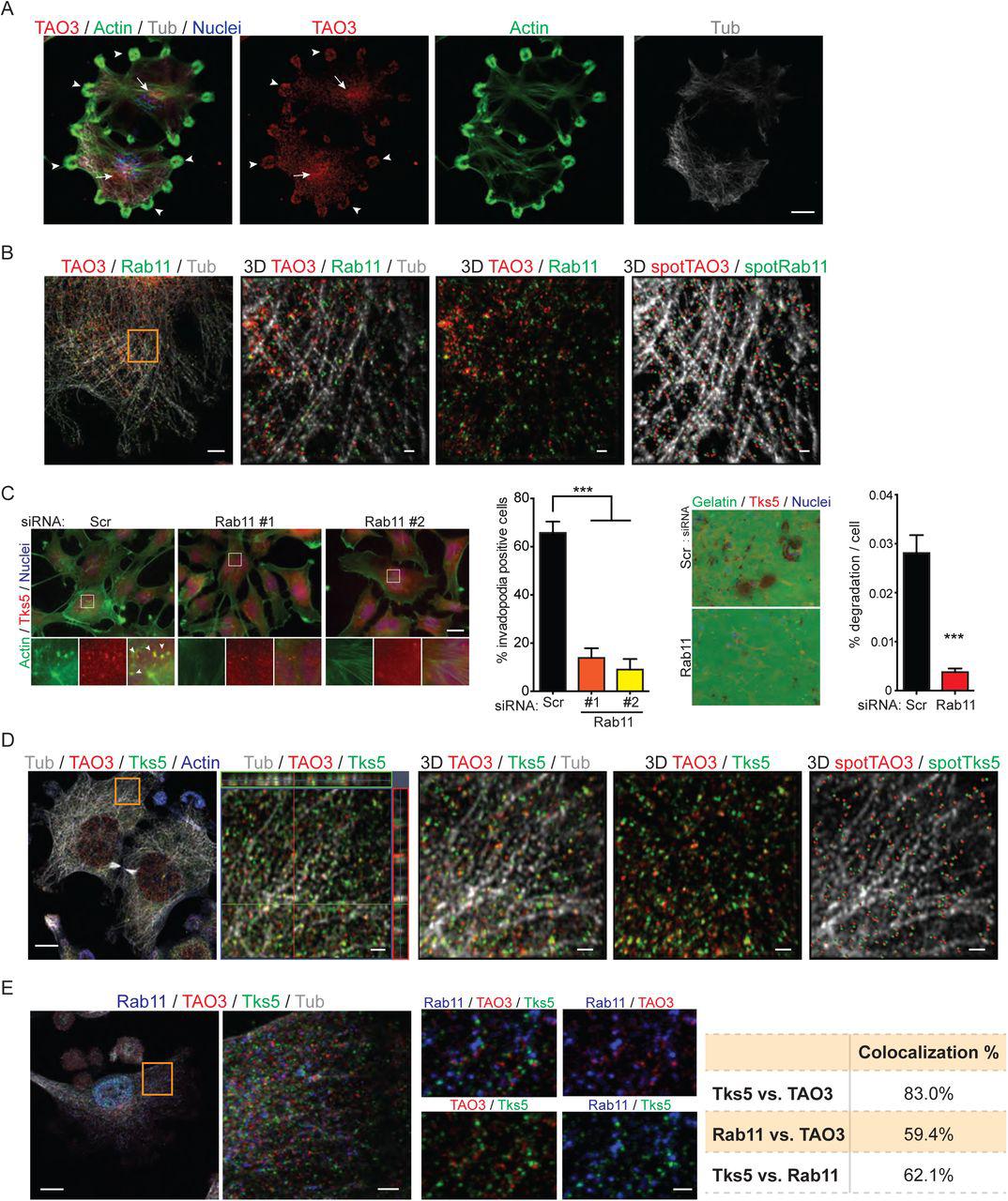
    A Distribution of TAO3. Staining of TAO3 (red), actin (green), tubulin (gray) and nuclei (blue in merged image only) in Src3T3 cells. Images were processed by maximum intensity projection. Arrowheads indicate invadopodial positioning of TAO3. Arrows indicate endosomal positioning of TAO3. B Colocalization of TAO3 and <t>RAB11.</t> Staining of TAO3 (red), RAB11 (green) and tubulin (gray) in Src3T3 cells. Images were processed by maximum intensity projection (left) and 3D reconstruction using Imaris software (3D, magnified area from orange square in left image). Colocalized TAO3 and RAB11 were spotted and shown with tubulin (3D spot, right). C Invadopodia formation (left) and gelatin degradation (right) analysis in C8161.9 cells with siRNA-scrambled and –RAB11. Two individual siRNA-RAB11 (#1 and #2) were used for invadopodia assay. Pool-siRNA-RAB11 (four siRNAs) was used for degradation assay. Representative images (left) and percentage of invadopodia positive cells or percentage of degradation per cells (right). Immunofluorescence staining of invadopodia by actin (phalloidin, green) and TKS5 (red), and Hoechst to denote nuclei of cells. Arrowheads indicate TKS5+ invadopodia. D Colocalization of TAO3 and TKS5 α . Staining of tubulin (gray), TAO3 (red), TKS5 α (green) and actin (blue) in Src3T3 cells. Images were processed by maximum intensity projection (left). Magnified area (orange square in left) was shown as orthogonal view (second left) and 3D reconstruction by Imaris software (3D). Colocalized TAO3 and TKS5 α were spotted and shown with tubulin (3D spot, right). E Colocalization of RAB11, TAO3 and TKS5 α . Staining of tubulin (gray), RAB11 (blue), TAO3 (red) and TKS5 α (green) in Src3T3 cells. Images were processed by maximum intensity projection (left). Magnified area (orange square in left) shown (second left, single plane z-stack image) and higher magnification images are shown in small four panels with different combination of channels. Colocalization between each RAB11, TAO3 and TKS5 α was analyzed by Imaris software and shown in table (right). Scale bars, 10 μm (A, B left, D left and E left), 1 μm (B and D right three), 2 μm (E second left) and 20 μm (C). Data shown in panel C is n=6 to 7 in each experimental group and were validated in two separate experiments. P >0.05 unless other specified; ***, P <0.001.
    Wild Type Human Rab11, supplied by Addgene inc, used in various techniques. Bioz Stars score: 93/100, based on 1 PubMed citations. ZERO BIAS - scores, article reviews, protocol conditions and more
    https://www.bioz.com/result/wild type human rab11/product/Addgene inc
    Average 93 stars, based on 1 article reviews
    wild type human rab11 - by Bioz Stars, 2026-02
    93/100 stars
      Buy from Supplier

    Image Search Results


    A Distribution of TAO3. Staining of TAO3 (red), actin (green), tubulin (gray) and nuclei (blue in merged image only) in Src3T3 cells. Images were processed by maximum intensity projection. Arrowheads indicate invadopodial positioning of TAO3. Arrows indicate endosomal positioning of TAO3. B Colocalization of TAO3 and RAB11. Staining of TAO3 (red), RAB11 (green) and tubulin (gray) in Src3T3 cells. Images were processed by maximum intensity projection (left) and 3D reconstruction using Imaris software (3D, magnified area from orange square in left image). Colocalized TAO3 and RAB11 were spotted and shown with tubulin (3D spot, right). C Invadopodia formation (left) and gelatin degradation (right) analysis in C8161.9 cells with siRNA-scrambled and –RAB11. Two individual siRNA-RAB11 (#1 and #2) were used for invadopodia assay. Pool-siRNA-RAB11 (four siRNAs) was used for degradation assay. Representative images (left) and percentage of invadopodia positive cells or percentage of degradation per cells (right). Immunofluorescence staining of invadopodia by actin (phalloidin, green) and TKS5 (red), and Hoechst to denote nuclei of cells. Arrowheads indicate TKS5+ invadopodia. D Colocalization of TAO3 and TKS5 α . Staining of tubulin (gray), TAO3 (red), TKS5 α (green) and actin (blue) in Src3T3 cells. Images were processed by maximum intensity projection (left). Magnified area (orange square in left) was shown as orthogonal view (second left) and 3D reconstruction by Imaris software (3D). Colocalized TAO3 and TKS5 α were spotted and shown with tubulin (3D spot, right). E Colocalization of RAB11, TAO3 and TKS5 α . Staining of tubulin (gray), RAB11 (blue), TAO3 (red) and TKS5 α (green) in Src3T3 cells. Images were processed by maximum intensity projection (left). Magnified area (orange square in left) shown (second left, single plane z-stack image) and higher magnification images are shown in small four panels with different combination of channels. Colocalization between each RAB11, TAO3 and TKS5 α was analyzed by Imaris software and shown in table (right). Scale bars, 10 μm (A, B left, D left and E left), 1 μm (B and D right three), 2 μm (E second left) and 20 μm (C). Data shown in panel C is n=6 to 7 in each experimental group and were validated in two separate experiments. P >0.05 unless other specified; ***, P <0.001.

    Journal: bioRxiv

    Article Title: The serine-threonine kinase TAO3 promotes cancer invasion and tumor growth by facilitating trafficking of endosomes containing the invadopodia scaffold TKS5α

    doi: 10.1101/2020.02.27.968305

    Figure Lengend Snippet: A Distribution of TAO3. Staining of TAO3 (red), actin (green), tubulin (gray) and nuclei (blue in merged image only) in Src3T3 cells. Images were processed by maximum intensity projection. Arrowheads indicate invadopodial positioning of TAO3. Arrows indicate endosomal positioning of TAO3. B Colocalization of TAO3 and RAB11. Staining of TAO3 (red), RAB11 (green) and tubulin (gray) in Src3T3 cells. Images were processed by maximum intensity projection (left) and 3D reconstruction using Imaris software (3D, magnified area from orange square in left image). Colocalized TAO3 and RAB11 were spotted and shown with tubulin (3D spot, right). C Invadopodia formation (left) and gelatin degradation (right) analysis in C8161.9 cells with siRNA-scrambled and –RAB11. Two individual siRNA-RAB11 (#1 and #2) were used for invadopodia assay. Pool-siRNA-RAB11 (four siRNAs) was used for degradation assay. Representative images (left) and percentage of invadopodia positive cells or percentage of degradation per cells (right). Immunofluorescence staining of invadopodia by actin (phalloidin, green) and TKS5 (red), and Hoechst to denote nuclei of cells. Arrowheads indicate TKS5+ invadopodia. D Colocalization of TAO3 and TKS5 α . Staining of tubulin (gray), TAO3 (red), TKS5 α (green) and actin (blue) in Src3T3 cells. Images were processed by maximum intensity projection (left). Magnified area (orange square in left) was shown as orthogonal view (second left) and 3D reconstruction by Imaris software (3D). Colocalized TAO3 and TKS5 α were spotted and shown with tubulin (3D spot, right). E Colocalization of RAB11, TAO3 and TKS5 α . Staining of tubulin (gray), RAB11 (blue), TAO3 (red) and TKS5 α (green) in Src3T3 cells. Images were processed by maximum intensity projection (left). Magnified area (orange square in left) shown (second left, single plane z-stack image) and higher magnification images are shown in small four panels with different combination of channels. Colocalization between each RAB11, TAO3 and TKS5 α was analyzed by Imaris software and shown in table (right). Scale bars, 10 μm (A, B left, D left and E left), 1 μm (B and D right three), 2 μm (E second left) and 20 μm (C). Data shown in panel C is n=6 to 7 in each experimental group and were validated in two separate experiments. P >0.05 unless other specified; ***, P <0.001.

    Article Snippet: Plasmids encoding wild-type human RAB11 (#12679) was obtained from Addgene.

    Techniques: Staining, Software, Invadopodia Assay, Degradation Assay, Immunofluorescence

    A, TAO3-GFP (green) was overexpressed in Src3T3 cells and stained by Rab11 (red) and Actin (phalloidin, blue). B, Distribution of Tks5. Staining of Tks5 (red), actin (green), tubulin (gray) and nuclei (blue) in Src3T3 cells. Images were processed by maximum intensity projection. Arrowheads indicate invadopodial positioning of Tks5. Arrows indicate endosomal positioning of Tks5. Magnified area (orange square in left) was shown (right). C, Accumulation of Tks5 at Rab11+ endosomal vesicles. Staining of Tks5 (red), Rab11 (green), tubulin (gray) and actin (phalloidin, blue) in Src3T3 cells. Images were processed by maximum intensity projection (top three panels) with different combination of channels indicated in each image. Invadopodia formation was inhibited by SU11333 (middle three) or SBI-581 (bottom three) and stained. Magnified images (orange square in left) were shown as orthogonal view (second left) or 3D reconstruction by Imaris software (3D, right two with different combination of channels shown in each images). Scale bars, 10 μm (A, B left and C left), 1 μm (B right) and 2 μm (C second left and right).

    Journal: bioRxiv

    Article Title: The serine-threonine kinase TAO3 promotes cancer invasion and tumor growth by facilitating trafficking of endosomes containing the invadopodia scaffold TKS5α

    doi: 10.1101/2020.02.27.968305

    Figure Lengend Snippet: A, TAO3-GFP (green) was overexpressed in Src3T3 cells and stained by Rab11 (red) and Actin (phalloidin, blue). B, Distribution of Tks5. Staining of Tks5 (red), actin (green), tubulin (gray) and nuclei (blue) in Src3T3 cells. Images were processed by maximum intensity projection. Arrowheads indicate invadopodial positioning of Tks5. Arrows indicate endosomal positioning of Tks5. Magnified area (orange square in left) was shown (right). C, Accumulation of Tks5 at Rab11+ endosomal vesicles. Staining of Tks5 (red), Rab11 (green), tubulin (gray) and actin (phalloidin, blue) in Src3T3 cells. Images were processed by maximum intensity projection (top three panels) with different combination of channels indicated in each image. Invadopodia formation was inhibited by SU11333 (middle three) or SBI-581 (bottom three) and stained. Magnified images (orange square in left) were shown as orthogonal view (second left) or 3D reconstruction by Imaris software (3D, right two with different combination of channels shown in each images). Scale bars, 10 μm (A, B left and C left), 1 μm (B right) and 2 μm (C second left and right).

    Article Snippet: Plasmids encoding wild-type human RAB11 (#12679) was obtained from Addgene.

    Techniques: Staining, Software

    A Trafficking of TKS5 α -positive vesicles was captured by time-lapse imaging (200ms/image for 1 min, total 300 images/film) in Src3T3 cells expressing TKS5 α -mCherry and YFP-Tubulin. Movie was processed for color-coded time projection (top left) and magnified area (orange square) was shown as color-coded time projection (bottom left) and separated channels in time frame (selected time point during 0-8 sec). B SBI-581 inhibits TKS5 α -positive vesicle trafficking. The movies were taken from cells with treatment of DMSO or SBI-581 (100nM) for 1 min (200ms interval). Trafficking of all TKS5 α -positive vesicles was shown by color-coded time projection (left), time trajectory displacement length (second left), plotting graph of length/displacement length (middle) with percentage of TKS5 α + vesicle moving (pie chart) and displacement length (right). C SBI-581 inhibits the trafficking of a fraction of Rab11+ vesicles. The movies were taken from cells with treatment of DMSO or SBI-581 (100nM) for 1 min (200ms interval). Trafficking of all Rab11 positive vesicles was shown by plotting graph of length/displacement length (left) with percentage of Rab11+ vesicle moving (pie chart) and displacement length (right). Scale bars 2 μm (A, B and C). Data shown in panel B and C are mean SEM of biological replicates from 2 or more separated experiments. P >0.05 unless other specified; ***, P <0.001.

    Journal: bioRxiv

    Article Title: The serine-threonine kinase TAO3 promotes cancer invasion and tumor growth by facilitating trafficking of endosomes containing the invadopodia scaffold TKS5α

    doi: 10.1101/2020.02.27.968305

    Figure Lengend Snippet: A Trafficking of TKS5 α -positive vesicles was captured by time-lapse imaging (200ms/image for 1 min, total 300 images/film) in Src3T3 cells expressing TKS5 α -mCherry and YFP-Tubulin. Movie was processed for color-coded time projection (top left) and magnified area (orange square) was shown as color-coded time projection (bottom left) and separated channels in time frame (selected time point during 0-8 sec). B SBI-581 inhibits TKS5 α -positive vesicle trafficking. The movies were taken from cells with treatment of DMSO or SBI-581 (100nM) for 1 min (200ms interval). Trafficking of all TKS5 α -positive vesicles was shown by color-coded time projection (left), time trajectory displacement length (second left), plotting graph of length/displacement length (middle) with percentage of TKS5 α + vesicle moving (pie chart) and displacement length (right). C SBI-581 inhibits the trafficking of a fraction of Rab11+ vesicles. The movies were taken from cells with treatment of DMSO or SBI-581 (100nM) for 1 min (200ms interval). Trafficking of all Rab11 positive vesicles was shown by plotting graph of length/displacement length (left) with percentage of Rab11+ vesicle moving (pie chart) and displacement length (right). Scale bars 2 μm (A, B and C). Data shown in panel B and C are mean SEM of biological replicates from 2 or more separated experiments. P >0.05 unless other specified; ***, P <0.001.

    Article Snippet: Plasmids encoding wild-type human RAB11 (#12679) was obtained from Addgene.

    Techniques: Imaging, Expressing